

When fishermen cannot go to sea, they repair their nets is a well known metaphor regarding productivity during downtime that neatly sums up my Christmas and New Year period.
Something that had been nagging me for a good while now is the apparent erosion in willingness of participants to be as fully present in online workshops as they once were, and I concluded that whatever the reason, it was up to me to do whatever I could about it. As a freelancer with relatively few resources, a theatrical background and a love of creative solutions, I pride myself on delivering online workshops that punch above their weight. Obviously my content and course design can always be improved, but I felt the time was ripe to give my punch a bit more variety, as any single view – no matter how appealing – will become familiar, and we all know where that leads. Drawing inspiration from a television programme from my childhood called Vision On, a number of YouTube videos that have memorably held my attention and a keynote speech I once attended, I set to work. Having decided on the qualities and functions that I wanted to realise, I spent my spare time over a couple of weeks redesigning my Zoom broadcast system before digging through boxes of cables and repurposing old kit. Then it was a case of reconfiguring some of the software and most of the technology I use for online delivery from my home office.
I’ve since tested it in two workshops, received feedback that included specific positive references to the new architecture, and have pronounced myself satisfied. So this post is for anyone who provides their work in a similar way, and who may be interested in adding visual variety to their online output.
I was lucky enough to see the late Sir Ken Robinson’s last public, in-person appearance – an intimate evening at the Roundhouse in London on January 21st 2020. There might have been about one hundred or so people there that night, and once we had been ushered into the space, we all waited expectantly. I was there on my own, and so passed the time checking my phone, looking around the room, up at the lights and studying the other people in the audience. After a while I looked to the side of the auditorium and noticed that he was already there, standing in a doorway just a few feet away and chatting with someone. He seemed neither trying to hide nor be recognised; he was just in conversation, and after a few minutes made his way slowly to the front while acknowledging various people in the audience that I assumed he knew, and then began. I remember being captivated not just by seeing one of my favourite speakers in the flesh, but also by the line between private moment and public performance being almost indistinguishable. The blurring seemed to effortlessly blend backstage into onstage and private thought into public statement.
Wanting those feelings of safety, ease and welcome for the beginning of my workshops gave me the idea to set up what Chat GPT has since christened the vibe cam. It’s a wide-angled camera mounted high up and to the side of my desk that gives an over-the-shoulder view of my workspace. I’ve never much cared for the Zoom waiting room, so I’ve replaced it and the first thing my audience now sees is a view inspired by the Pearl & Dean sting that was ubiquitous in the UK’s cinemas during the 1970’s.
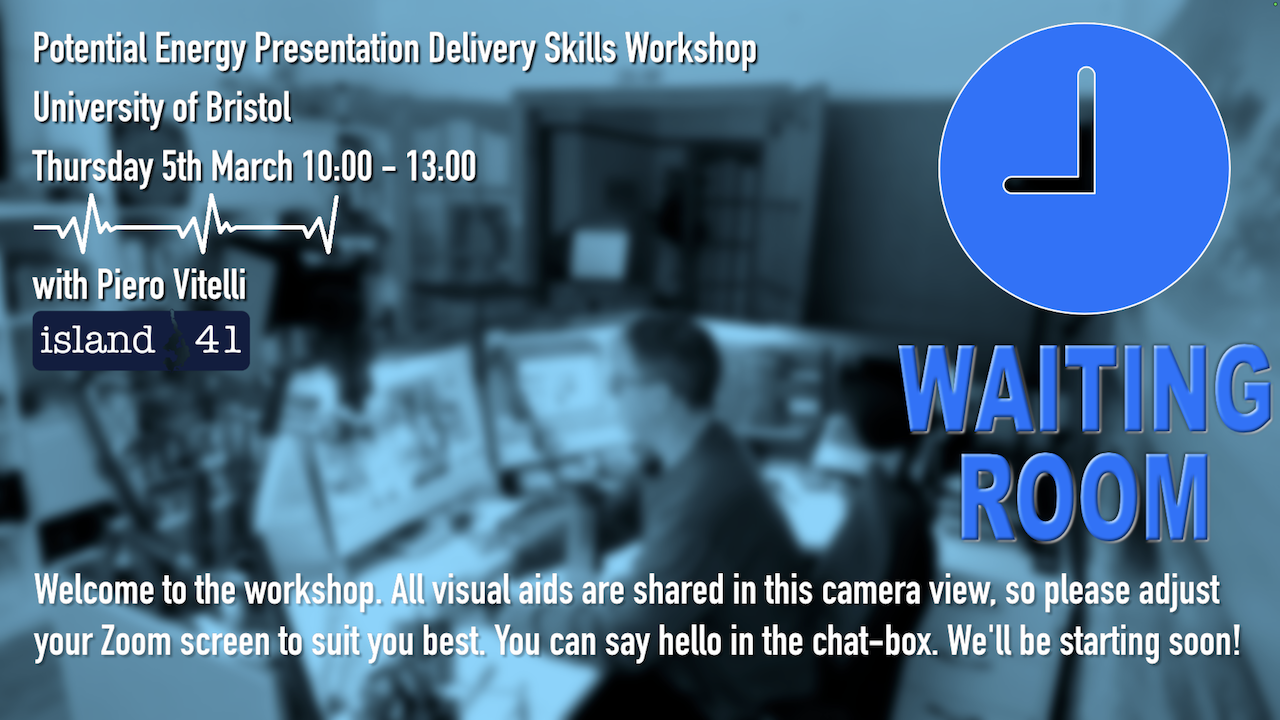
With background music playing, on screen titles and graphics providing information – and a monochromatic live view of my office that is slightly out of focus, participants can settle in. It’s never easy to be the first person on a Zoom call, and so this view is designed to create a sense of presence without the presumption of interaction. I’ll normally wait until there are at least two or three people in the room before the view sharpens to one of me at my desk cluttered with pieces of paper, scribbled post-it notes, pairs of glasses, lights, a water bottle, monitors, wires and my coffee cup. The music stops automatically as the scenes crossfade, and with my microphone now live, I can say hello, chat about the day and perhaps the weather while I make my final preparations and we wait until it’s time to start. No pressure, no expectations and no need to do anything except relax.
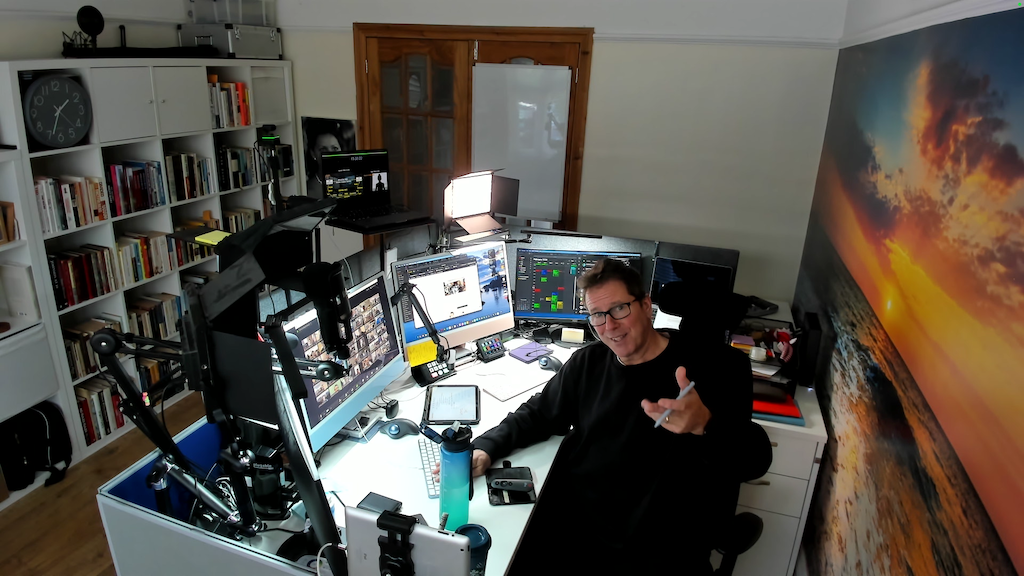
With the ability to display and hide graphics on any view at the click of a button, I can put a QR code on the screen for the audience to register their attendance, and it’s also the view I sometimes use when they come back from a break. Once everything is ready, it takes one click of a button to cross fade from the backstage vibe cam to the onstage main cam on which I introduce the workshop, facilitate discussions, invite contributions and sometimes display infographics or relevant websites. It has purpose and feels, I hope, just like a friendly meeting room.

I’ve long preferred to present standing as it gives me better control of my energy and my voice. With a single button press, another one-second crossfade gives me just enough time to stand, before the view switches to the presenter cam, which is a tracking cam that can follow me when I move, and is positioned at standing height and set well back from my desk. With the help of a green screen behind me, I design my slides with a space for me within them, allowing me to interact with my material as directly as I do with the audience. It may be my home office, but it looks and feels a bit like a performance space.

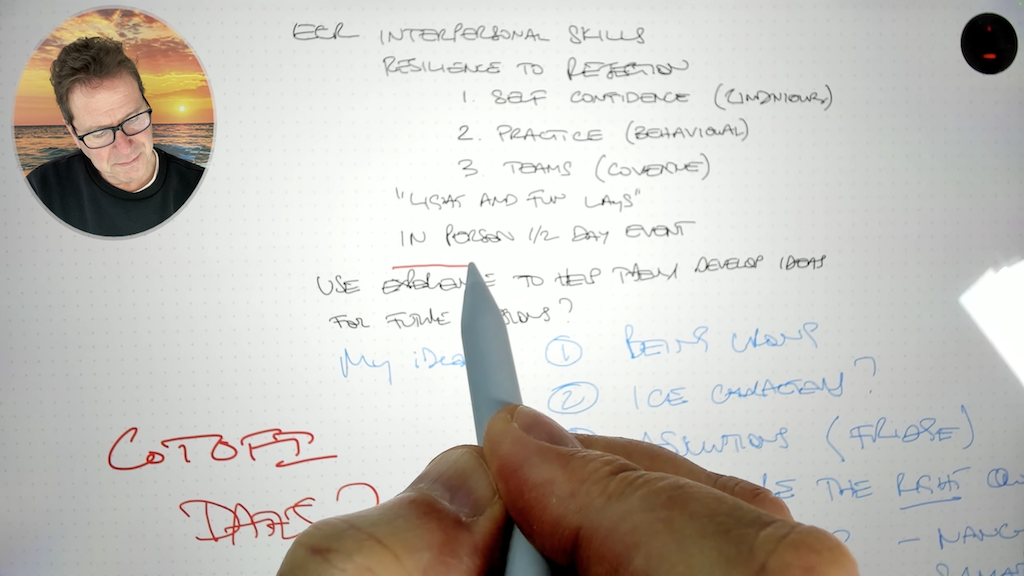
With presentations given on my feet and facilitation taking place seated, I also want the chance to create real-time, hand-drawn images – a deliberately low-tech alternative to on-screen graphics that lets people see my thinking as it happens. I can’t draw to save my life and have handwriting that even a doctor wouldn’t be able to decipher, but I do think there is something engaging about watching someone sketch out ideas on a Flipchart, and my repurposed overhead cam, combined with an iPad, gives me the chance to do just that while I hear Left Bank Two (the theme tune from Vision on) playing in my head. The icing on this particular cake is Apple’s “auto-refine handwriting” feature, which uses some sort of magic to adjust my handwriting and render it slightly more legible than it otherwise would be.
OBS (Open Broadcaster Software) is where all these artistic decisions about how my workshop should look on camera are assembled into something coherent. It receives multiple live inputs – cameras, slides, graphics, browser windows – and combines them into the five distinct scenes described and shown above. They are controlled by a piece of equipment called the Stream Deck, a photo of which is the main image for this post. It’s a bank of programmable buttons that allow me to choose what my audience sees, when, and for how long. Their job is to remove friction and allow me to preserve momentum, which means my audience can enjoy the variety that live vision mixing brings and their focus can remain where it belongs: on the ideas being shared, rather than the machinery required to share them.
It’s important to say that none of this technology improves the content nor makes the workshops I give inherently better. It doesn’t and that isn’t the point. Its purpose is to help a solo facilitator work effectively with limited resources. It allows for televisual variety in an online environment: by crossfading smoothly between different states for presenting and facilitating, by panning to a place where hand drawn scribbles offer relief from polished graphics, and through widening the shot to a natural scene of intimacy that comes from letting an audience see the human moments where backstage and onstage briefly overlap.
Whether all this effort to mend my nets translates into a sustained level of higher engagement remains to be seen of course, but the process of designing and realising these changes has been exciting to do, and has made my workshops even more enjoyable to deliver. If you want to swap ideas about how to make online workshops more effective or discuss any aspect of what I share in this post, get in touch!